
{主关键词}
出发吧爱情
China takes overseas archaeology from Silk Road to South America_我的网站

一 |
China is set to launch its first joint archaeological project in South America, following an agreement between Chinese and Peruvian institutions to study the ancient Caral civilization. The move marks a new milestone in the country's growing overseas archaeological cooperation.
The Institute of Archaeology of the Chinese Academy of Social Sciences, Peru's Caral Archaeological Zone under the Ministry of Culture, and the Professional School of Archaeology at the National University of San Marcos signed a cooperation agreement on Saturday to conduct research on the ancient Caral civilization.
The Caral civilization, which is considered to be the oldest civilization discovered in the Americas, emerged along Peru's northern coast and dates to around 3000 BC to about 1800 BC.
The project marks China's first joint archaeological initiative in South America, expanding its overseas archaeological footprint to four continents: Asia, Africa, Europe and South America. It also encompasses cooperation with Belt and Road partner countries, major centers of ancient civilizations and regions crucial to the study of human origins.
For Chinese archaeologists, the project represents a new step in overseas archaeological engagement and international cooperation, fostering mutual learning and dialogue among civilizations, Chinese experts said.
Cooperation beyond borders
In recent years, Chinese institutions have participated in a series of overseas archaeological projects, from exploring ancient cities along the Silk Road to studying early civilizations in Africa and Central Asia.
They not only brought Chinese expertise and talent, but also advanced Chinese technologies, equipment and solutions, experts said.
In February, a significant archaeological breakthrough has emerged from Mit Rahina in Giza, the site of ancient Memphis in Egypt, where a joint Chinese-Egyptian mission has uncovered a limestone structure believed to be connected to the temple of King Pharaoh Apries from Egypt's 26th Dynasty (664-525 BC), according to the Xinhua News Agency.
Zhang Hai, head of the Chinese team and an archaeologist from Peking University, told the Global Times in a previous interview that the Chinese contingent applied distinctive methods for documenting and recording finds, while deploying Chinese-developed technologies such as the "4D kankan Meta" 3D scanner for precise, real-time topographic and sectional modeling, plus specialized software for capturing dislocated stone elements in 3D to aid future digital restoration and preservation.
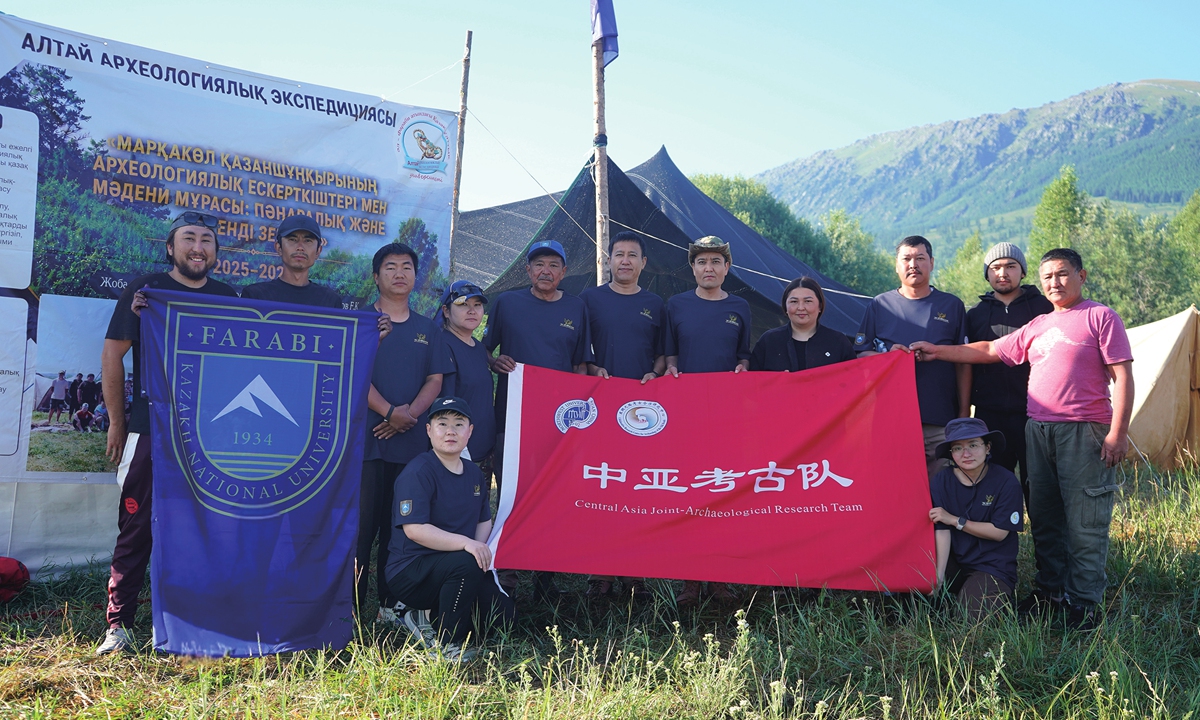
In the latest China-Kazakhstan joint archaeological project, Chinese equipment and technologies played an important role in the team's discoveries.
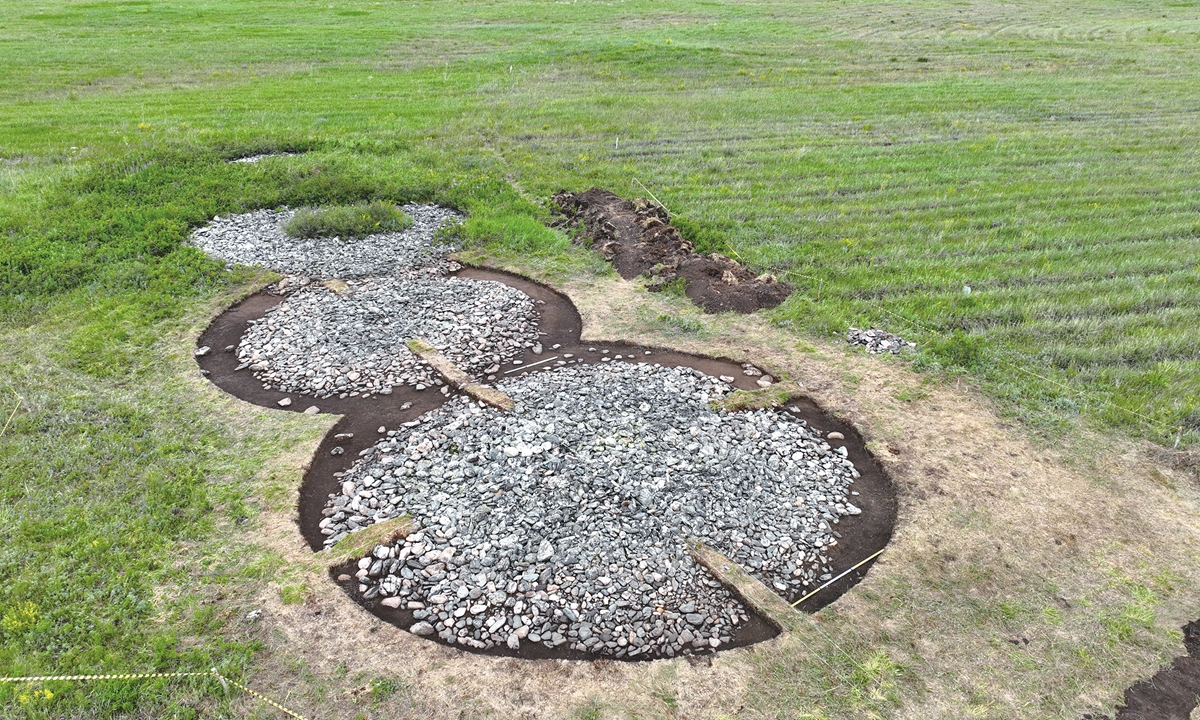
Building on the excavation, the archaeological team used drones and the "I Survey" mobile field documentation system to conduct systematic surveys around the excavation area. The survey covered more than 10 burial grounds and documented more than 50 Pazyryk-era tombs.
Pazyryk culture flourished from the late sixth century BC to the third century BC, Shao Huiqiu, a professor at the Collaborative Research Center for Archaeology of the Silk Roads, Northwest University, told the Global Times.
According to Shao, who is the Chinese lead for the China-Kazakhstan joint archaeological project, none of the tombs had previously undergone formal excavation, giving them significant research potential. The use of these technologies has enabled the team to carry out more efficient and comprehensive surveys of the area,
During the China-Kazakhstan joint archaeological project, archaeologists have recovered a number of important artifacts, including human remains, pottery, gold foil pieces, horse bones and iron horse equipment.
The finds have provide valuable material evidence for studying the burial practices, funerary customs and material culture of the Pazyryk culture in the Lake Markakol region, said Shao.
Researchers also conducted regional surveys around the excavation area, documenting more than 50 Pazyryk-era tombs.
Through the joint archaeological project, China and Kazakhstan have gained a deeper understanding of Bronze Age to Early Iron Age archaeological remains in the Lake Markakol basin, according to Shao.
In 2027, the two sides will continue excavations at key sites and burial grounds identified during the survey, while advancing regional archaeological investigations, data analysis, multidisciplinary research, young archaeologist training and academic exchanges.
Archaeological exchanges
China's overseas archaeological cooperation has also become a platform for broader exchanges among researchers and civilizations.
Such projects, experts say, are helping expand archaeological research beyond national borders and provide new perspectives on exchanges among ancient civilizations.
China's overseas archaeology has grown alongside its broader participation in global cultural heritage protection.
The National Cultural Heritage Administration's cultural heritage development plan through 2030 calls for expanded archaeological cooperation in Austronesian-speaking regions, trans-Himalayan areas, and routes connected to the Silk Road and Maritime Silk Road, reported Xinhua.
The plan seeks to strengthen the methods used to trace Chinese cultural artifacts overseas, and advance efforts to retrieve lost cultural relics.
It also pushes for greater Chinese participation in global cultural heritage governance and expanded international partnerships, including new protection cooperation agreements with more countries worldwide, according to Xinhua.
In these joint collaborations, researchers from different countries bring together their expertise in regional archaeology and fieldwork, conducting exchanges on archaeological surveys, excavations, multidisciplinary research and regional cultural studies. Such cooperation has strengthened mutual learning and laid a foundation for long-term partnerships, according to Shao.
The China-Uzbekistan cooperation has established research centers in Samarkand and Termez to support studies on human-environment interactions and cultural heritage. The initiative has also trained professionals in Silk Road archaeology, scientific research and heritage conservation through programs for Uzbek universities and research institutions, while promoting international academic exchanges to advance Silk Road heritage protection and cultural cooperation, noted Zhu Jiangsong, a member of the China-Uzbekistan joint archaeological team from the School of Cultural Heritage, Northwest University.
Through these partnerships, Chinese archaeologists are not only contributing technology, research experience and training, but also gaining first-hand materials and fresh perspectives that help advance the study of ancient civilizations and enrich China's archaeological research.
。 AI摘要 在固原市泾源县,厦门援宁医生林菊丽发现,患者从不喊疼。她组建全女性医护团队,推广微创手术,提升当地诊疗水平,留下技术,助力医疗帮扶持续发展。 林菊丽(白衣者)参与义诊。(受访者 供图) 在固原市泾源县工作一年,厦门援宁医生林菊丽发现了一个“秘密”:这里的患者,几乎没人喊疼。 乳腺微创手术打局麻,疼痛感常让患者忍不住叫出声。在泾源县,林菊丽总要问患者:“疼不疼?疼就说。”得到的回答往往是:“你们大老远来帮我们看病,这点疼算什么,不疼!”一位教师患者术后,林菊丽特意叮嘱,如果晚上疼就找护士拿药。第二天林菊丽查房时问起,对方说:“医生,我昨晚等了一晚上,也没等来疼痛。

二 | ”当时林菊丽信了,但事后再回想,心里一阵酸楚:“哪有人不怕疼,患者是怕给我们添麻烦啊。

三 | ” 林菊丽的故事,只是厦门医疗队援宁三十载接力中的一个缩影。2023年9月,厦门市妇幼保健院乳腺外科副主任医师林菊丽如愿踏上援宁路。她前后报名多年,这次终于被排上。清晨从厦门起飞,一路向西,离家越来越远,辗转奔波至晚上9点才抵达泾源县。 当地乳腺外科多为男医生,加上传统观念束缚,女性患者羞于就诊,宁可坐4小时车去西安求医。林菊丽向院长申请组建一支全女性医护团队。仅用一天,专科门诊便组建起来。

四 | 她带领团队下乡义诊一个月,当地护士当起语言“翻译”,“厦门的林医生”名声很快传开,患者纷至沓来。 当时,一位肉芽肿性乳腺炎患者每周末都要坐4小时车去西安治疗,往返奔波,已有数月之久。林菊丽接手后,先用药控制,再择机手术,患者逐渐康复。如今,两人仍保持联系,患者定期把复查报告发来,每次都念叨一句话:“希望你回来走走。” 林菊丽深知,留下技术比看病更重要。她发现,由于专业技术力量薄弱,当地乳腺疾病普查率偏低,许多患者因此延误治疗。自己援宁一年,能做的终究有限,必须把技术留下。她多方奔走,手把手教当地女医生,推广创伤小、恢复快的微创手术——这项技术操作难度适中,尤其适合县级医院开展,患者术后即可出院,无需反复奔波,特别适合当地交通不便的实际状况。

五 | 令林菊丽欣慰的是,一年间她在多个帮扶点累计完成微创手术110多台,患者术后反馈良好。但她也坦承一个遗憾:由于帮扶期仅一年,当地医生尚未能独立掌握这项技术,“希望未来能有专业技术人员接力,让这项技术真正在泾源县扎根,持续惠及当地百姓”。 这也让林菊丽在实践中摸索出一条新路:她不局限于定点单位泾源县人民医院,而是主动联系周边医疗机构,多点开展手术、参与义诊筛查。这种打破“定点帮扶”壁垒的做法,获得当地各医疗单位以及主管部门的高度认可,并将其作为典型推广——后期前往宁夏的专技人员,可以借鉴这一模式,形成跨区域的“专技人员共享”格局。各专业医生短缺时,不同县、区之间可以互通有无、协调支援,让有限的优质医疗资源服务更多群众。

六 | 像林菊丽这样的援宁厦门医生,三十年来从未断档。厦门医疗队跨越山海,用医术治愈病痛,用仁心温暖人心,接力续写闽宁协作新篇。林菊丽离开泾源县那天,许多患者拉着她的手,重复着那句最朴素的话:“真希望你一直都在这里。”(厦门日报记者 何无痕)。
Current article:http://cuozubeishenjingli.cfd/list_th4h0/j2dlt.html
Published on:16:30:00
- 2796527外交部:美方应立即停止恶意网络攻击并作出负责任的解释_外交部:美方未就网袭西工大作回应_有关
- 41782关键战役全部缺席,库明加已连续三场未获上场机会但勇士全胜
- 6108原诺安基金投资部执行总监“老鼠仓”非法获利1445万元,被判有期徒刑11年_邹翔_邹凡
- 55477漳浦金鲳鱼苗 首次出口马来西亚
- 7480911K分辨率VR相机Insta360 Titan:8个镜头,99 888元
- 7207901Windows 10笔记本电脑Dell XPS 13新的2.25毫米相机分辨率:四个镜头
- 543987三面环山的西湖区龙门坎村 24人紧急转移 拎包住进酒店
- 924Chinese authorities order local probe, nationwide market check over wholesaler using formaldehyde to keep cabbages fresh: report
- 49182新股中签了,钱是从哪扣的?是不是只要账户里有钱就行?忘记留够钱会怎样?
- 192063生意社:本周炼焦煤市场延续偏强运行态势
- 1453研究:蝙蝠身上发现的病毒与埃博拉病毒有关。
- 102工业和信息化部部长苗伟:预计下半年5G手机将投放市场。
- 5761691有序实施停课措施,非必要不外出!杭州市教育局发布提醒
- 7414Ticket sold in California wins Powerball jackpot of $1.73 billion
- 886From an online "weight-loss hack" to protective manicures: The humble bean that connects harvest, community and home in Shandong
- 947【观点】正信期货:锌价暂有突破震荡区间势头
- 96027京东回应说,iPhone的降价是苹果授权的,苏宁表示这是年终折扣。
- 515德安东尼回忆湖人执教往事:愿意接手是因为纳什
- 2620545Ranil justifies tax hikes amidst criticism
- 109内马尔亲自招募!乌拉圭后卫:和他交谈是一种荣幸,我很感谢他
- 301小贾巴里:我试着给球队带来能量 我们必须在进攻端做出改变
- 3807919【现货】8月26日全国菜粕现货价格汇总
我的网站热门国内
- Copyright @ 2016-2017 我的网站 版权所有